


Welcome to this slight rebranding of Substack Summer, because well it’s no longer summer. You can find all previous Substack Reviews under the new Substack Reviews section.
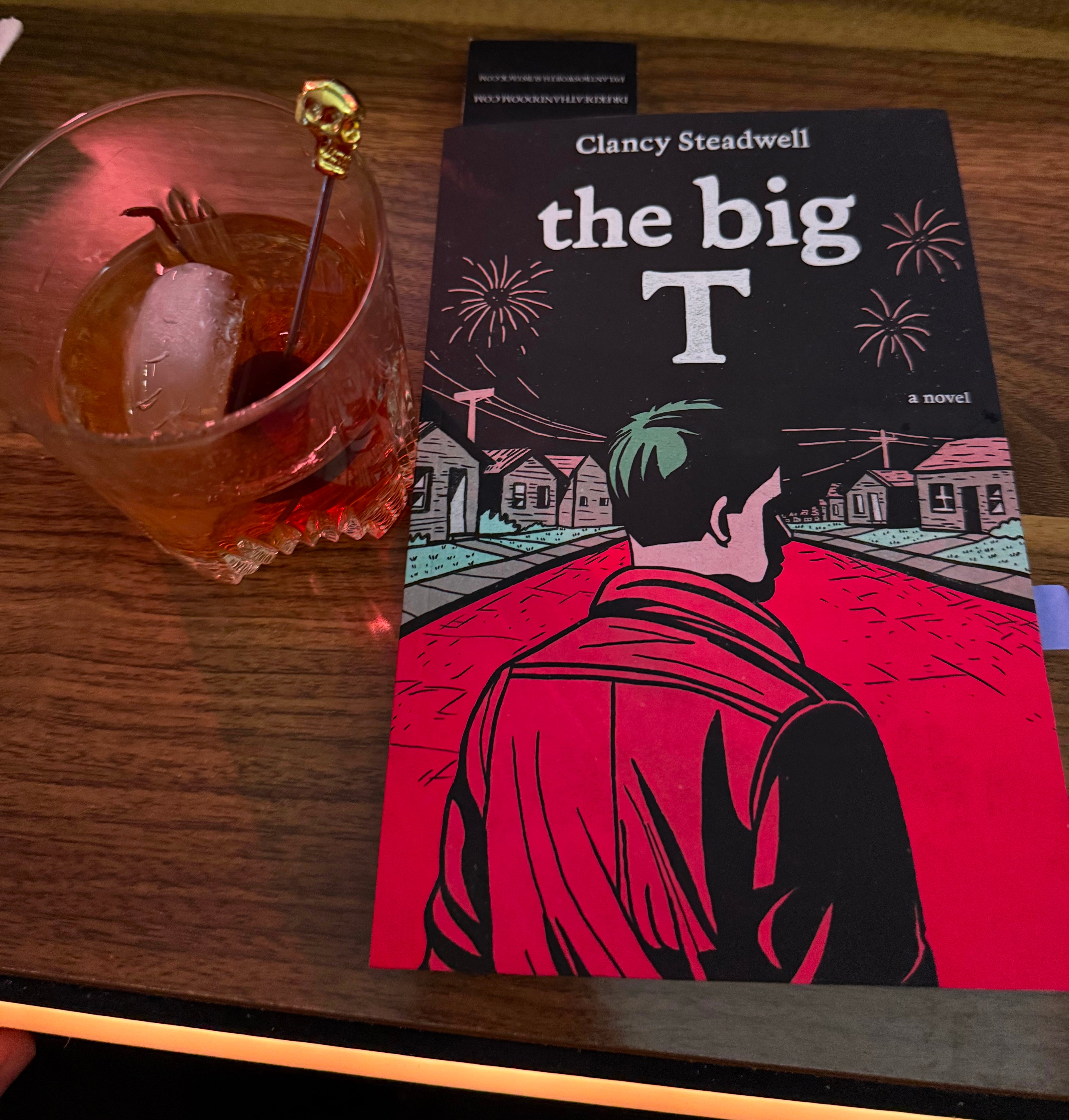
Just the Facts
Title: The Big T (stylized: the big T)
Author: Clancy Steadwell
Format: Paperback.
Genre: Bildungsroman (which is a fancy way of saying: coming of age story)
Substack: Persona Non Propria
Length: 236 pages.
Vinny’s Blurb: the big T is a timeless coming-of-age tale that follows best friends, Jude and Tommy (“the big T”) through high school into young adulthood. The story touches on all the hallmarks of adolescence while weaving the aspects of American life carefully and thoughtfully throughout. the big T is an accomplishment in a genre that I would’ve told you was played out. Steadwell’s deft hand at storytelling and narrative voice elevates this is to the upper echelons of the coming-of-age novels.
I got rid of my old “pump the tires” section, but in the interest of full disclosure Clancy left me a very nice inscription inside this book. And a sticker. I’m a sucker for stickers. Anyway, you’ll be pleased to know that the rest of the book is somehow even better than nice things written about me…
James Clancy and the Giant big T
I’ll get this out of the way early: the big T is one of the best books I’ve read this year, full stop. What’s more, Clancy Steadwell takes a genre that is so loaded with tropes, cliches and well-worn paths and just executes it with nimble dexterity.
There’s nothing ground-breaking about the big T — teens in a hollowed out suburban town, high school, college, drugs, young love, regrets — but the nuances of the storytelling make it feel fresh and new. Jude, the narrator/protagonist, feels realer than character in any novel that I can immediately recall. I want to hammer on this for a moment because it is essential to understanding the achievement and appeal of the big T. I’ve always been drawn to Holden Caulfield (Catcher in the Rye), but at some base-level there is a disconnect with Holden; he’s a full-detailed character but he was always that: a character. Jude feels like someone I could look up on Facebook and find right now. To have a character this believable and real as the narrator and one of the central figures makes the whole story so much more compelling.
I wrote in my notes that you couldn’t make the big T into a movie1 because so much of it is worn territory that it would risk looking and feeling derivative. the big T succeeds because it is a novel, because Jude exists as its introspective centerpiece. Rebecca Makkai recently wrote an article about the difference between film and novel writing, and if you want an example of a how to do the latter, the big T is a shining example. The magic is in the way it is written and how the story is experienced through Jude.
Which isn’t to say that the big T doesn’t have its own standout moments. “The Legacy of Parade Day” is a laugh-out-loud funny chapter that feels like a cut scene from Animal House2. It’s also not to say that it doesn’t break from genre convention (none of the young love stories end like you think they will but end how they should!). Another one of its triumphs is the subtle way it touches on modern America without ever drifting into didactics. Politics, socioeconomics, public vs. private schooling, sexual identity, race, drug use… these all appear and are touched on but are never preached. They exist how these things exist in the real world: as part of the lived experience, coloring and shading every aspect of our interpersonal interactions and only rarely bubbling to the surface.
I’ve gotten this far, and I haven’t touched on “the big T,” Jude’s best friend, Tommy. Jude may be our narrator, but this story follows Tommy3. Tommy is one of those characters you love despite him. You can probably think of a few people in your own life like that off the top of your head. He is the match that burns bright, but that you know from page one will not burn long. Steadwell does an impeccable job of making you love him, envy him, hate him, forgive him, pity him; the full gamut of emotions you inevitably experience with a best friend.
I’m not a Beatles fan, but I always liked the song “Hey Jude.” The song figures into the story in clever ways, but the magic of the reference is in the connection that is never explicitly made. “Hey Jude” starts like this:
Hey Jude, don’t make it bad.
Take a sad song and make it better.
That’s what the big T does. It takes the sad song of transitioning into adulthood and makes it better; it finds the little joys and the silver linings and the memories that live on amidst the acne, virginity, awkwardness, and realization of mortality that comes with, uh, coming of age.
the big T is a beautiful novel, and — with apologies to Sir Paul McCartney — you should go out and get her.
You absolutely could. Take one part The Sandlot, one part Stand by Me, one part My Girl, and one part Breakfast Club, blend until smooth. 73% on Rotten Tomatoes. It is in no way “unfilmable” you just lose most of the magic.
Again, timeless quality.
Probably why it’s named after him, Vinny. Great insight as always.
You've convinced me to get it. Great review.
Nice write up Vinny! I also felt it was a top read this year, but you captured the essence of why it was so good. Well done.